Protspect
Protein sequence spectral analysis
Turn residue-property signals into reproducible features for proteins and peptides. Choose an embedding, apply a transform, and export coefficients or aligned channel products through one API. Use the same workflow for individual sequences, sequence collections, paired chains, and fitted machine-learning pipelines.
BLOSUM100, ten Kidera factors, AAindex1 properties, AAindex2/3 matrix profiles, or your own mapping.
Fourier, circular Z, finite discrete Mellin, or discrete wavelets, with explicit axes and preprocessing.
SequenceSet and ComplexSet share coefficient export and coordinate-aware selection.
SequenceTransformer freezes grids, channel moments, selection, and feature names for sklearn pipelines.
Important
This site documents Protspect 0.1.0a2, including Kidera, AAindex,
alternative transforms, and the unified API. Alpha APIs may change.
Follow Getting started to install the code these tutorials use.
The import is protspect; it is separate from the language-model prototype
and the unrelated prospect and ProSpect distributions.
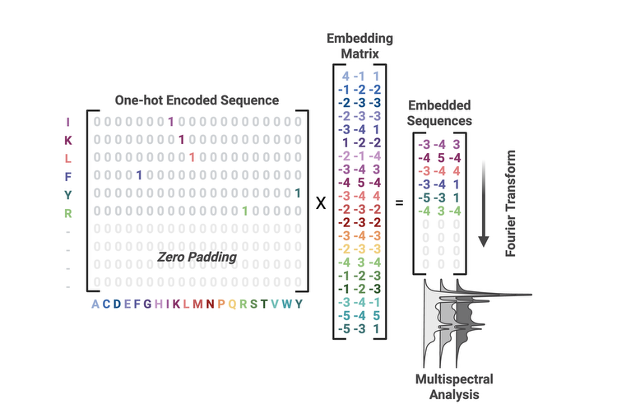
One-hot residues become channel signals through a matrix multiplication. The Fourier transform acts along sequence rows, independently per channel. How the workflow fits together explains the shapes and the zero-padding convention.
from protspect import SequenceSet

sequences = SequenceSet(method="fourier", compute_cross_spectra=False)
sequences.from_sequence_list(["ACDE", "ACDF"], length=8)
table = sequences.export_features("amplitude")
assert table.shape == (2, 160)
Where to begin
New to spectral features? Read How the workflow fits together, then From a sequence matrix to a spectrum. For modelling, follow Train within a reproducible Pipeline before the Compare MLPs on antimicrobial peptides benchmark. For comparisons between residue representations, explore Explore the residue-embedding atlas.