How the workflow fits together
A peptide is a sequence of residue identities, not a time series of measured intensities. Protspect turns each identity into numerical channel scores, treats the ordered scores as finite signals, and transforms those signals. The result is a representation for analysis; its usefulness for a task requires evaluation.

The core matrix view
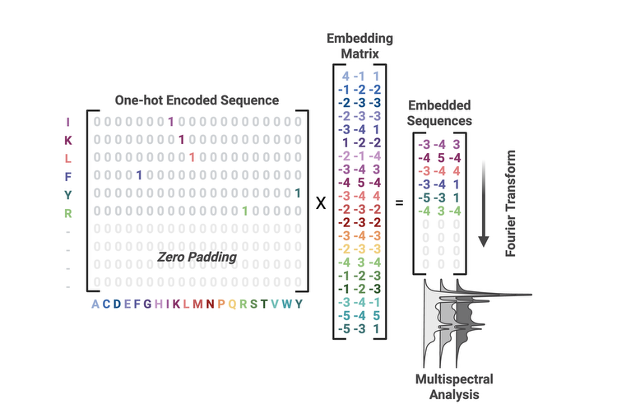
The project-provided illustration shows the core calculation.
A one-hot sequence has shape \(N\times20\), and its residue embedding
matrix has shape \(20\times C\). Multiplication produces \(N\times C\)
ordered channel signals. Zero-padding adds sequence rows, giving
\(L\times C\). The Fourier transform then acts along the length axis,
independently for each channel: fft(padded_signals, axis=0). Neither the
20-residue alphabet axis nor the channel axis is transformed in this step.
Protspect performs the embedding by lookup, without allocating the one-hot
matrix. The From a sequence matrix to a spectrum tutorial constructs both forms and
checks their equality. If centering or normalization is enabled, operate on
real embedded rows first and only then append all-zero rows.
Five decisions to make explicitly
Embedding. Which residue properties define each channel? BLOSUM100 is a substitution-score profile, Kidera supplies ten statistical factors, and AAindex supplies properties or matrix profiles. These choices are not learned protein-language-model embeddings.
Preprocessing. Choose whether to center each sequence and how to scale it. Statistics over actual residues must precede padding. Dataset-level channel standardization, when enabled, must learn only from training chains.
Transform. Fourier/Z describe angular-frequency coefficients; Mellin uses positive residue positions and log-frequency; wavelets retain band and position. Their axes are not interchangeable.
Features. Export signed real/imaginary coefficients, magnitudes, phases, or aligned products. Select coordinates using their named axes.
Evaluation. Freeze the grid and representation policy, fit within CV, select models on training validation, and evaluate on held-out data.
The common objects
transform_sequence and Sequence.compute_transform return a
TransformResult containing channel arrays, coordinate arrays, and metadata.
SequenceSet shares a grid across many sequences. ComplexSet applies the
same transform to each chain and forms ordered coefficient products.
SequenceTransformer performs this featurization in sklearn and freezes
training-only state. Existing FFT names adapt to this implementation.
Fixed grids and honest comparisons
A common length keeps output columns aligned, but padding is still a modelling choice. More bins can sample an existing Fourier response more densely without creating new sequence information. A wavelet filter and boundary rule determine coefficient count. Channel count and feature count affect MLP parameter count. Keep these differences visible when comparing models.
These are descriptors, not physical interaction energies, causal explanations, or a guarantee of length or scale invariance. Magnitudes discard phase; wavelet magnitudes also discard coefficient signs. Cross-products inherit preprocessing and scaling. See Export and select coefficient features for what each choice retains and loses.